
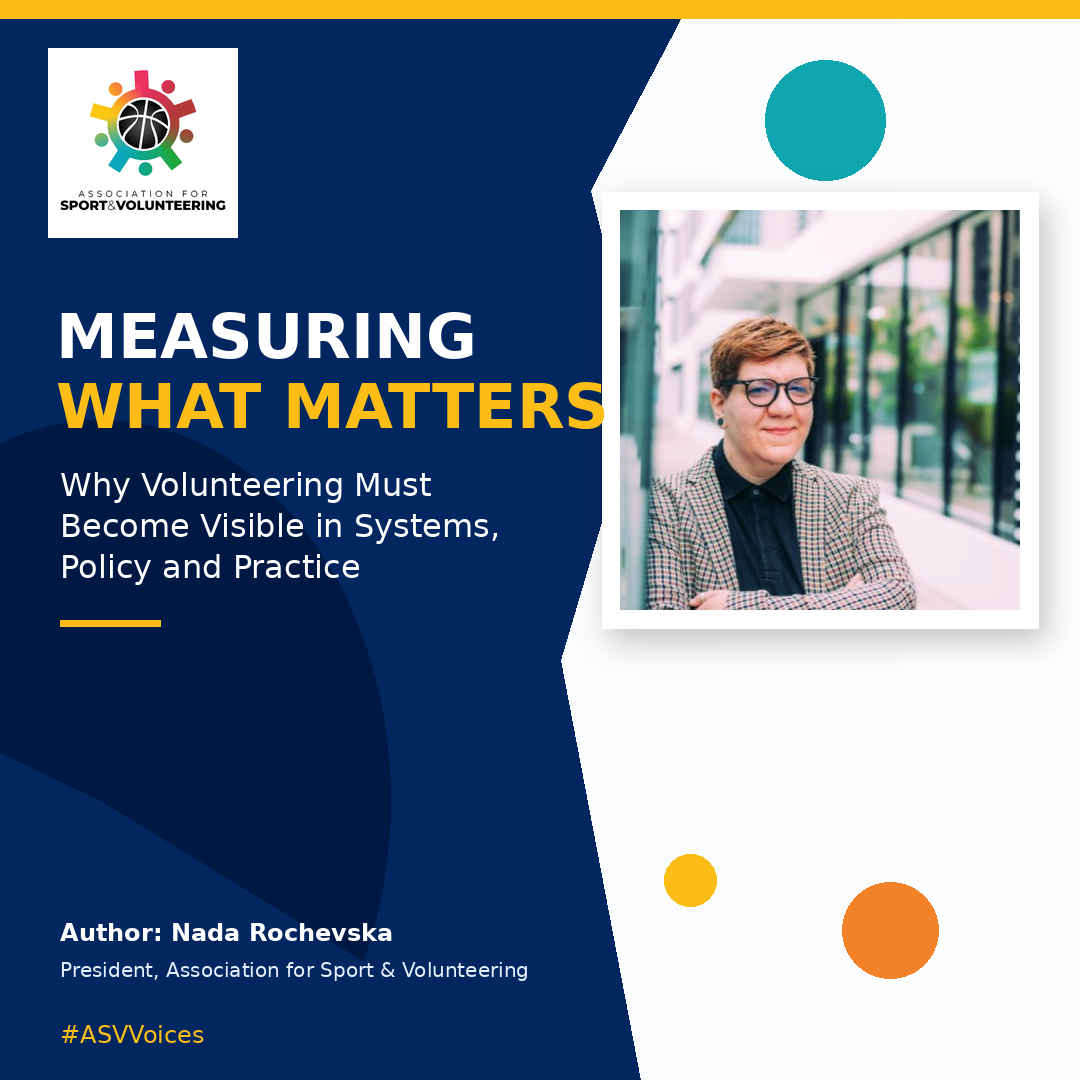
Volunteering is often described through numbers: how many people volunteered, how many hours they gave, and what economic value their contribution represents.
These numbers matter. They help institutions, governments, organizations and communities understand the scale of volunteering. They also help make a case for investment, recognition and support.
But numbers alone do not tell the full story.
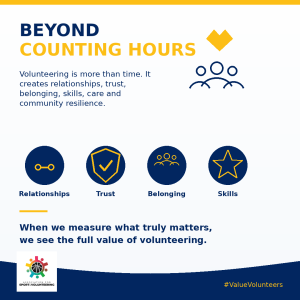
Anyone who has worked closely with volunteers knows that volunteering is not only a contribution of time. It is also relationships, trust, belonging, skills, care and community resilience. It is often the invisible layer that helps societies respond when formal systems are under pressure.
At ASV, we believe that this invisible contribution must become more visible.
The 2026 State of the World’s Volunteerism Report, Volunteerism and its Measurements, and the Global Webinar Series hosted by United Nations Volunteers open an important conversation: why measurement matters, why it matters now, and how volunteering can be better understood beyond traditional statistics.
Beyond counting hours
For many years, volunteering has been measured mainly through participation rates, hours worked and economic value. This has been useful, especially in helping policymakers and institutions understand that volunteering has real social and economic importance.
However, this approach is incomplete.
If we only count hours, we may miss the deeper value of volunteering. We may miss the confidence a young person gains through their first civic role. We may miss the social connection created for an older adult. We may miss the trust built between communities and institutions. We may miss the skills developed through sport events, local initiatives, crisis response or inclusion programmes.
Most importantly, we may miss the role of volunteers as part of the human infrastructure of society.
Volunteers do not only support activities. They help systems function. They connect people. They create access. They often reach places where institutions alone cannot.
If we do not measure it, we do not see it
One of the most important questions raised by the current global discussion on volunteerism is simple:
If we do not measure volunteering properly, do we truly support it?
When something is not measured, it often remains invisible. When it remains invisible, it is less likely to be prioritized. And when it is not prioritized, it rarely becomes part of policy, planning, budgets or long-term institutional design.
This is one of the reasons volunteering is still often praised emotionally but under-supported structurally.
Volunteers are thanked. Volunteers are celebrated. Volunteers are invited when help is needed.
But too often, volunteer systems are not planned, funded, coordinated, protected or evaluated with the same seriousness as other parts of social development.
This is the gap that needs to change.
Volunteering as human infrastructure
For ASV, the shift is not only technical. It is conceptual.
The question is not only how to improve data collection. The deeper question is how we understand the role of volunteering in society.
Volunteers should not be seen only as a support mechanism or an additional workforce. They should be recognized as part of the human infrastructure that allows communities, organizations and institutions to function.
This is especially important in sport, youth work, crisis response, inclusion, education and local community development.
In these areas, volunteers often create continuity, trust and access. They carry local knowledge. They support participation. They help people feel seen, included and connected.
When volunteering is understood in this way, measurement becomes more than a statistical exercise. It becomes a tool for better system design.
What should be measured?
A stronger approach to measuring volunteering should look at more than quantity.
It should ask:
What value does volunteering create for the individual?
Does it support learning, confidence, employability, well-being, belonging and personal development?
What value does it create for the community?
Does it strengthen inclusion, trust, access, participation, solidarity and resilience?
What value does it create for organizations and public systems?
Does it improve capacity, quality, outreach, cooperation and sustainability?
What environment makes volunteering possible?
Are volunteers trained, protected, recognized, supported and included? Are organizations equipped to manage volunteers responsibly? Are policies, funding and coordination mechanisms in place?
These questions help move volunteering from the margins of public discussion into the centre of development, inclusion and community-building.
Why this matters for ASV
ASV works with volunteering not only as an activity, but as a system.
Through sport, inclusion, youth engagement, education and international cooperation, we see how volunteering can open pathways for participation and belonging. We also see how fragile volunteering becomes when it depends only on goodwill.
Goodwill is powerful, but it is not enough.
Volunteers need structure. Organizations need capacity. Communities need coordination. Institutions need evidence. Policymakers need data that shows not only how many people volunteer, but why volunteering matters and what conditions allow it to create long-term impact.
This is why measurement is not a technical detail. It is a foundation for visibility, investment and better decision-making.
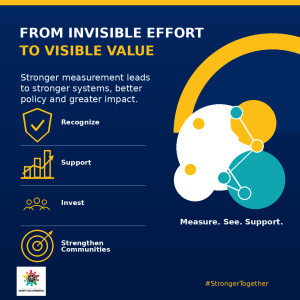
From invisible effort to visible value
The future of volunteering will not be strengthened only by asking more people to help.
It will be strengthened by understanding what volunteers already contribute, what they need in order to continue, and how systems can be designed to support them better.
Volunteering is not only something people do in their free time. It is part of how societies build trust, respond to challenges, include different groups and create shared responsibility.
To measure volunteering properly is to make it visible.
To make it visible is to give it value.
And to give it value is to finally treat volunteering as what it truly is: a vital part of social infrastructure.
At ASV, we believe this is the direction volunteering must take. Not only more recognition, but better understanding. Not only more celebration, but stronger systems. Not only counting hours, but measuring what truly matters.
Further reading: United Nations Volunteers, 2026 State of the World’s Volunteerism Report: Volunteerism and its Measurements.
#unvolunteers #unvolunteering #UNV #volunteeringmeasurments #volunteers #UN