
Nada Rochevska, Sport Volunteer Management Expert | Ecosystem Builder & Policy Advisor May 19, 2026
I have been spending a lot of time reflecting on the recently launched 2026 State of the World’s Volunteerism Report (SWVR). The data provides a staggering baseline: 2.1 billion people volunteer globally every single month (SWVR, 2026). This is an immense, largely untapped global resource that requires strategic investment, not just goodwill. I look at the sports sector, which relies heavily on this workforce to function. We love our volunteers. But reliance is not the same as strategic design.
Is our sport volunteer model designed for the reality we actually live in today?
The model and its logic. The traditional volunteer model has served grassroots sport for decades. Grounded in community spirit, its logic was simple. The old paradigm viewed volunteers largely through the lens of unremunerated labour, as individuals working of their own free will to support activities without remuneration (Cnaan et al., 1996). From this viewpoint, volunteers were largely seen as a free resource to cut event costs.
Organized sport has survived on this model. That effectiveness deserves recognition before anything else is said. And yet, as sport faces accelerating social and demographic shifts, I find myself asking whether this transactional model is sufficient for what comes next.
The tension is worth naming. What I observe across community sport is several intersecting crises that rarely get addressed systemically.
First, we face a 1.7 million-volunteer deficit relative to historical baselines (2016-2017). While recent data shows a post-pandemic recovery of 10.5 million active volunteers (Sport England, 2023/24), the primary barrier remains glaring: no extra time. Volunteers are increasingly unwilling to commit to year-round, unstructured demands.
Second, there is a stubborn diversity gap. Women, individuals with disabilities or long-term health conditions, and lower socio-economic groups remain chronically underrepresented. These demographics mirror the inequalities of sport participation itself. If volunteers do not reflect the community they serve, community sports clubs lose relevance and miss out on valuable operational skills.
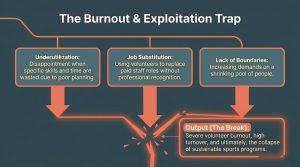
Finally, there is the burnout-and-exploitation trap. Underutilization of specific skills, job substitution without professional recognition, and a severe lack of boundaries place increasing demands on a shrinking pool of people. The inevitable output is severe volunteer burnout, high turnover, and ultimately, the collapse of sustainable sports programs.
These are not peripheral concerns. They are the defining challenges of our time.
What the model could evolve toward. In my work designing volunteer systems, I advocate for a complete conceptual shift. We must move away from the old paradigm of viewing volunteers as a cost-saving measure and recognize them as the Invisible Human Infrastructure.
Volunteers do not just support activities; they shape systems. They are the critical architecture that ensures access, creates continuity, and drives grassroots community engagement.
This evolution requires adopting a Win-Win Value Proposition. For the volunteer, it must offer career capital (CV boosts, free professional training), self-discovery, and well-being through deep community belonging that actively prevents burnout in life and career. For the organization, it yields sustainability, elevated ethical standards, and greater inclusivity.
What this evolution would look like in practice. Concretely, an evolved sport volunteer playbook would completely redesign the volunteer experience. It would:
- Implement strategic planning and precision matching: Stop treating volunteers as generic labour. We must bypass constraints by eliminating rigid time demands and align tasks directly with a volunteer’s unique talents and professional interests.
- Provide meaningful training and onboarding: Treat training as a direct investment in the volunteer’s professional CV. Organizations must structure development from basic orientation to hard logistical skills and top-tier soft and relational skills, such as cross-cultural communication.
- Target motivation and empowerment: Recognize the different architectures of motivation. Youth seek CV building; mid-life parents seek mutual aid; older adults seek serious leisure. We must empower input across all groups and let them lead.
- Offer recognition beyond the free t-shirt: Provide actionable value, constructive feedback, and professional affirmation that gives volunteers tangible references for their careers.
- Ensure retention through belonging: A supportive, welcoming environment is the ultimate retention tool. We must redefine strength by recognizing that our differences are our strengths.
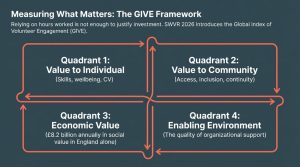
Crucially, we must also change how we measure success. Relying on hours worked is not enough to justify investment. Using the Global Index of Volunteer Engagement (SWVR, 2026), we must measure value across four distinct quadrants: Value to Individual, Value to Community, Economic Value, and the Enabling Environment.
A closing thought: Volunteering is not a cost centre to be minimized. It is a Win-Win business strategy.
By building the invisible human infrastructure through strategic planning, professional training, and genuine belonging, we secure the future of global sport. That is not a critique of what has been built or the volunteers who have carried us this far. It is an invitation to build further and to create a system worthy of their time.